
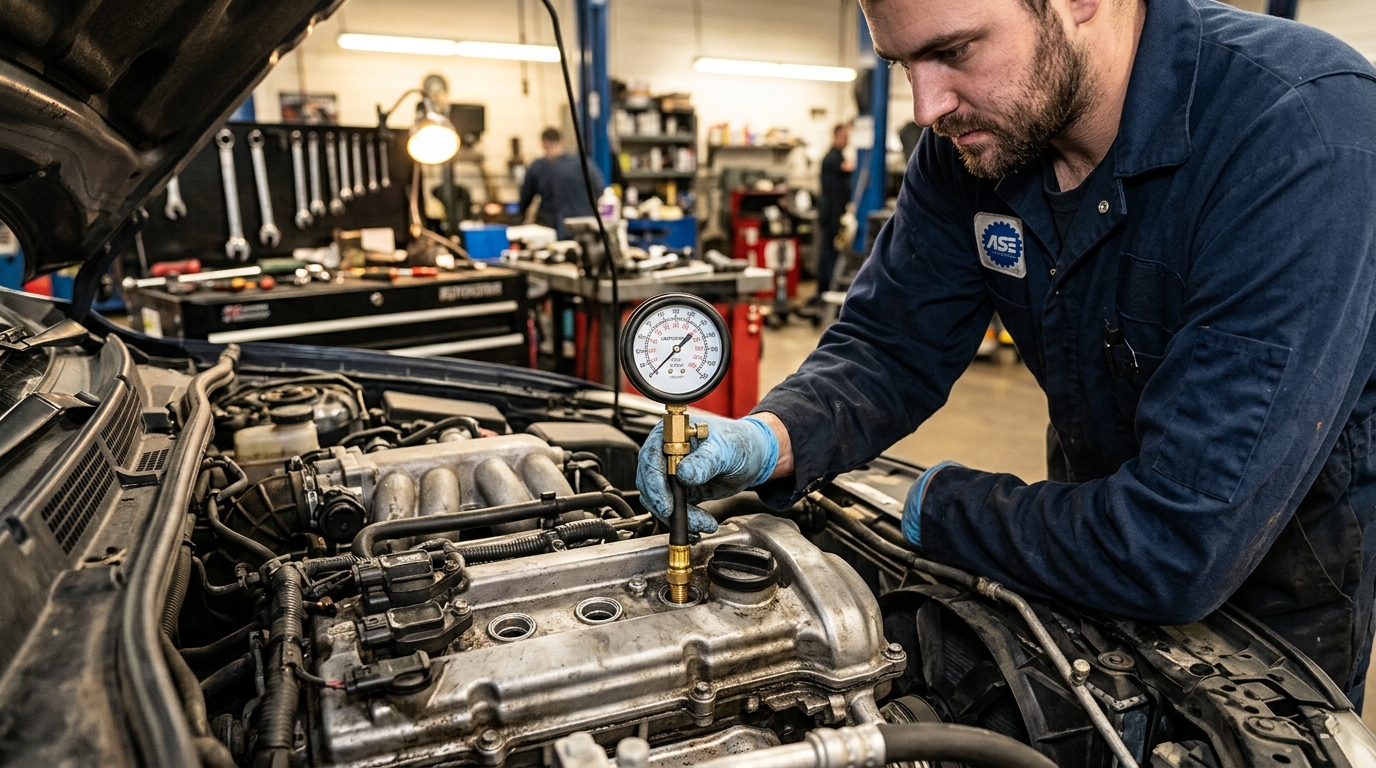
Your car started running rough. The power felt weak. You pressed the gas and nothing happened the way it should. A friend told you to “get a compression test.” You nodded and smiled. But inside, you had no idea what that meant. That is okay. By the end of this guide, you will know exactly what an engine compression test is, why it matters, and what to do with the results.
What Is an Engine Compression Test?
The Simple Definition
An engine compression test is a way to check how much pressure each cylinder inside your engine is building up. Think of it like squeezing a balloon. If the balloon has a small hole, it will not squeeze tight. The same idea applies to your engine’s cylinders.
When your engine runs, each cylinder takes in air and fuel, then squeezes that mixture very tightly before it is lit by a spark plug. This squeezing action is called compression. More squeeze means more power. Less squeeze means your engine is losing something important.
The test uses a small tool called a compression gauge or compression tester. You place it in the spark plug hole, crank the engine, and watch the number on the dial. That number is measured in PSI, which stands for pounds per square inch.
Why Does Compression Matter?
Your engine needs four things to run: fuel, air, spark, and compression. If any one of those is missing or weak, the engine will have problems. Most people think about fuel and spark first. But compression is just as important and is often forgotten until something goes wrong.
Low compression means your engine cannot squeeze the air-fuel mixture tight enough. This leads to misfires, rough idle, loss of power, and even higher fuel consumption. Catching this early can save you from a very expensive repair later.
Quick Fact: A healthy gasoline engine should produce cylinder pressure that is about 15 to 20 times its compression ratio. For most cars, that means readings between 140 and 200 PSI.
What Does a Compression Test Tell You?
Engine Problems It Can Find
Honestly, this is where the test gets really useful. A compression test is not just a number. It tells a story about what is happening inside your engine. Here are the main problems it can point to:
| Problem Found | What It Means |
| Worn piston rings | Air leaks past the piston, low compression in that cylinder |
| Leaking valves or bent valves | Compression escapes through the valve, pressure drops |
| Blown head gasket | Two cylinders next to each other show low or equal pressure |
| Damaged cylinder head | Cracks allow compression to escape, results vary |
| Flat camshaft / bad lifter | Valves not opening properly, compression stays low |
| Excessive carbon buildup | Can cause too-high compression or uneven readings |
Reading the Numbers: What Is Normal?
I remember the first time I looked at a compression test result. My neighbor handed me a piece of paper with numbers like 165, 162, 160, and 78. I had no idea what I was looking at. Let me save you that confusion.
The most important thing is consistency. All cylinders should be within about 10% of each other. If one cylinder is reading much lower than the others, that is your problem cylinder.
As a general rule for gasoline engines, a reading below 100 PSI in any cylinder is a serious red flag. Your engine needs at least that to even start and run. Most healthy engines will show readings between 140 and 200 PSI. Diesel engines work at much higher pressures, usually around 350 PSI or more, and need special tools to test.
According to Apex Tool Company, gasoline engines typically require about 140–160 PSI, while diesel engines need 350 PSI or more due to their compression-ignition design.
When Should You Do a Compression Test?
Signs Your Engine Needs One
You do not need to test compression every week. But there are clear signs that it is time to check. If your car shows any of these, a compression test is a smart first step before spending money on other repairs:
- 1
- Engine misfires or runs rough — one or more cylinders may not be firing because of low compression.
- 2
- Loss of power — your car feels weak and slow, especially when going uphill or overtaking.
- 3
- Higher fuel use — low compression makes the engine work harder, burning more fuel than usual.
- 4
- Blue or white smoke from the exhaust — oil burning or coolant entering the cylinder, both pointing to internal issues.
- 5
- Before buying a used car — it is always a good idea to check compression before you hand over your money.
- 6
- During a tune-up — many mechanics recommend doing a compression test every time you do a major service.
Hot Engine or Cold Engine?
This comes up a lot. Some guides say to warm the engine first. Others say the cold is fine. The truth is, most mechanics prefer a warm engine because the metal parts have expanded to their normal running size. This gives you the most accurate reading.
That said, a compression test on a cold engine will still give you useful information, especially if you are comparing cylinders to each other. The absolute numbers may be slightly different, but the pattern between cylinders stays the same.
To be fair, if you are testing an engine that will not start at all, cold is your only option. And that is perfectly fine too.
How to Perform an Engine Compression Test Step by Step
Tools You Will Need
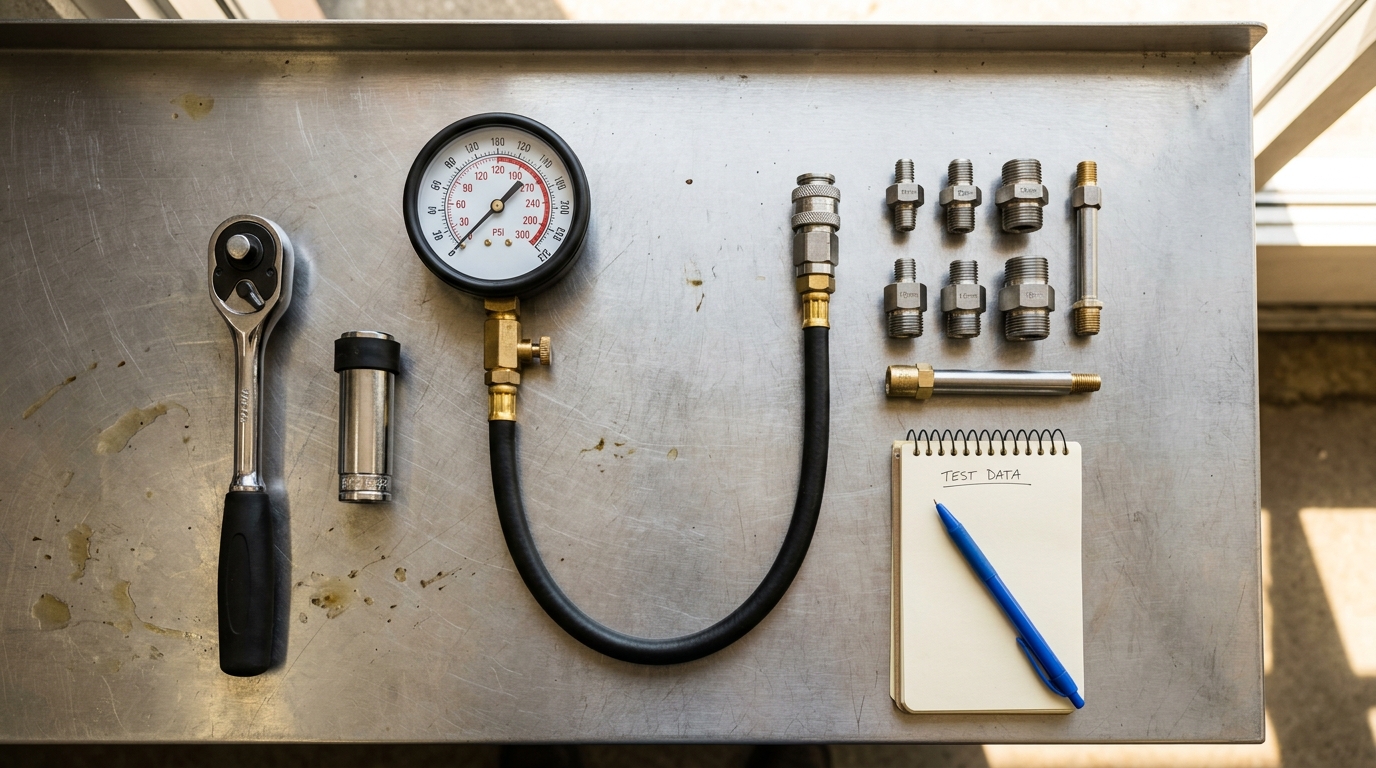
The good news is that this test does not need expensive tools. You can buy a basic compression test kit for under $30 at most auto parts stores. You can also rent one for free at many shops if you just need it once.
Here is what you need: a compression tester with the right adapter for your engine, a spark plug socket (usually 5/8 inch or 13/16 inch), a ratchet with extensions, a notepad to write down readings, and basic safety gear like gloves.
Step-by-Step Instructions
- 1
- Warm up the engine. Let it run for 5 to 10 minutes so the engine reaches its normal temperature. Then turn it off.
- 2
- Disable the ignition and fuel. You do not want the engine to start during the test. Disconnect the main ignition coil or pull the fuel pump fuse. On older cars with a distributor, unplug the coil wire.
- 3
- Remove all spark plugs. Take out every spark plug, not just the one you are testing. This lets the engine spin freely and gives you a more accurate reading from each cylinder.
- 4
- Thread the compression gauge into the first spark plug hole. Use the right adapter. Do not over-tighten. The gauge has a built-in valve to trap pressure inside.
- 5
- Open the throttle fully. Press the gas pedal all the way down (or have someone hold it open) so the engine gets maximum air intake during cranking.
- 6
- Crank the engine for 5 to 10 full revolutions. Use the starter motor. Watch the gauge climb and stop at the highest number. Write it down.
- 7
- Release the gauge pressure and move to the next cylinder. Press the release button on the gauge, then thread it into the next hole. Repeat for all cylinders.
- 8
- Compare your readings. Look for any cylinder that is more than 10% lower than the others. That cylinder has a problem worth investigating.
Pro Tip: Always label your cylinders on paper as you go. On a V6 or V8 engine, it is easy to lose track of which cylinder you tested. Number them from front to back on each bank.
Wet Compression Test vs Dry Compression Test
What Is the Difference?
Here is something most beginner guides skip. If you find a cylinder with low compression, there is a simple follow-up test called the wet compression test. It can tell you where the problem is coming from.
In a dry test, you test with everything normal. In a wet test, you pour a small amount of oil, about a tablespoon, into the cylinder with low compression through the spark plug hole. Then you test again right away.
If the compression goes up after adding oil, that tells you the piston rings are worn. The oil is temporarily sealing the gap that the rings cannot seal anymore. If the number stays low even with oil, the problem is likely in the valves or cylinder head, because oil cannot help a leaking valve.
How to Use the Wet Test Result
This is where the test really becomes useful as a diagnostic tool. Instead of guessing whether you need a valve job or a full engine rebuild, the wet compression test gives you a strong clue. It saves time and money at the mechanic.
I have seen people skip this step and get quoted for a complete engine rebuild when all they needed was a valve adjustment. Taking that extra five minutes can change everything about what repair you actually need.
The Society of Automotive Engineers (SAE) acknowledges that compression testing, while valuable, works best as one part of a broader engine diagnostics approach. See: NASA Speed News for more on interpreting results.
What Causes Low Engine Compression?
Common Causes and What They Mean
When compression test results come back low, people panic. I get it. But low compression does not always mean a total engine failure. The cause matters a lot.
The most common causes are worn piston rings, which let combustion pressure slip past the piston into the crankcase. After many miles, piston rings wear down naturally and cannot seal as well as they used to. Another common cause is a leaking valve. The intake or exhaust valves may not be closing fully, letting pressure escape before the combustion stroke.
A blown head gasket is a serious cause. This gasket sits between the engine block and the cylinder head. When it fails, compression from one cylinder can leak into the cooling system or into a neighboring cylinder. You will often see two adjacent cylinders showing similar low readings in this case.
Less common causes include cracks in the cylinder wall, a damaged or cracked piston, or timing issues where the valves are not opening and closing at the right time because of a worn timing chain or slipped timing belt.
What Causes High Compression?
Too-high compression sounds good but it can cause its own problems. This usually happens because of carbon deposits building up inside the combustion chamber. Carbon takes up space, which makes the chamber smaller and raises the effective compression ratio. The result can be pre-ignition or engine knock, which damages pistons and bearings over time.
If your engine is pinging or knocking on regular fuel, unusually high compression test readings might be part of the story.
Static vs Running Compression Test
The Standard Static Test
Everything we have talked about so far is what mechanics call a static compression test or cranking compression test. The engine is not running. You crank it with the starter and measure the pressure build-up. This is the most common method and works well for most engine troubleshooting situations.
It tells you if the cylinder can seal properly and build enough pressure. It is great for checking cylinder sealing on engines that are misfiring or not running at all.
What Is a Running Compression Test?
A running compression test is less common but very useful. Instead of cranking a non-running engine, you test the compression while the engine is actually idling. This gives you a picture of volumetric efficiency and how well each cylinder is pulling in and releasing air in real time.
The numbers will be different from a static test. A healthy running cylinder at idle typically shows much lower readings than a cranking test, often around 50 to 75 PSI. The value here is in comparing cylinders to each other. A cylinder with a stuck valve or timing issue will show up clearly in a running test, even if the static test looked okay.
Performance tuners use running compression tests to make sure each cylinder is contributing equally to the engine’s total output. It is also the test to run when a misfire shows up only at certain speeds or loads, and all the usual checks come back normal.
Compression Test vs Leak-Down Test
Why You Might Need Both
People often ask which test is better. Honestly, they answer different questions, and sometimes you need both.
A compression test tells you that a cylinder has low pressure. It confirms there is a problem. A leak-down test (also called a cylinder leakage test) tells you exactly where the pressure is going. In a leak-down test, you pressurize the cylinder with a known amount of air and then measure how much leaks out. You can hear where the air is escaping: out the exhaust means a bad exhaust valve, out the intake means a bad intake valve, out the oil cap means bad piston rings, and so on.
Think of the compression test as the first step. If you find a problem, the leak-down test is the second step that tells you what part to fix.
Which Test Is Easier?
A compression test is much easier and does not require the engine to be at top dead center on the compression stroke for each cylinder. A leak-down test requires more precision and a slightly more complex tool. For most DIY car owners, starting with a compression test makes total sense. Call in the leak-down test when you need to pinpoint the exact location of the leak.
Conclusion
An engine compression test is one of the most basic and most useful things you can do for your car. It does not need a lot of tools, it does not take long, and it gives you real information about what is happening inside your engine.
When your car feels weak, misfires, drinks too much fuel, or smokes from the exhaust, a compression test is the right first move. The numbers will tell you whether your cylinders are healthy, which one has a problem, and even give you a clue about what kind of problem it is.
The wet test versus dry test comparison can save you from an expensive and unnecessary rebuild. Knowing that your compression numbers should stay within 10% of each other is simple but powerful knowledge. And understanding the difference between a static test and a running test means you will never be lost when a mechanic mentions either one.
I would love to hear your thoughts. Have you ever done a compression test yourself? Did the results surprise you? Drop a comment below or share this guide with a friend who is dealing with engine troubles. You might just save them a big repair bill.
Frequently Asked Questions (FAQs)
How much does an engine compression test cost at a shop?
Most shops charge between $40 and $100 for a compression test, depending on how many cylinders your engine has. A 4-cylinder test takes less time than an 8-cylinder test. If you buy your own compression test kit, you can do it for as little as $20 to $30 and use it again whenever needed.
What PSI is too low for engine compression?
For most gasoline engines, any cylinder reading below 100 PSI is considered too low for the engine to run properly. Healthy readings usually fall between 140 and 200 PSI. The more important thing is that all cylinders are within about 10% of each other. One cylinder at 90 PSI when others are at 165 PSI is a clear sign of internal damage in that cylinder.
Can I drive a car with low compression?
You can usually drive a car with mildly low compression in one cylinder, but it is not a good idea for long. The engine will run rough, burn more fuel, and the problem will likely get worse over time. If two or more cylinders show low compression, driving the car can cause more serious damage. It is best to get the problem checked by a mechanic as soon as possible.
Do I need to warm up my engine before a compression test?
A warm engine gives you more accurate results because the metal parts have expanded to their normal running size. Let the engine run for 5 to 10 minutes before testing. That said, if the engine will not start at all, you can still do a cold compression test and get useful information. The key is to compare cylinders to each other, and that comparison is valid whether hot or cold.
What is the difference between a compression test and a leak-down test?
A compression test measures how much pressure each cylinder builds up when the engine is cranked. It tells you that a problem exists. A leak-down test pressurizes the cylinder with outside air and measures how fast that air escapes. It tells you where the problem is coming from, whether that is the valves, piston rings, head gasket, or cylinder wall. Use a compression test first to spot the problem, then a leak-down test to pinpoint the source.