
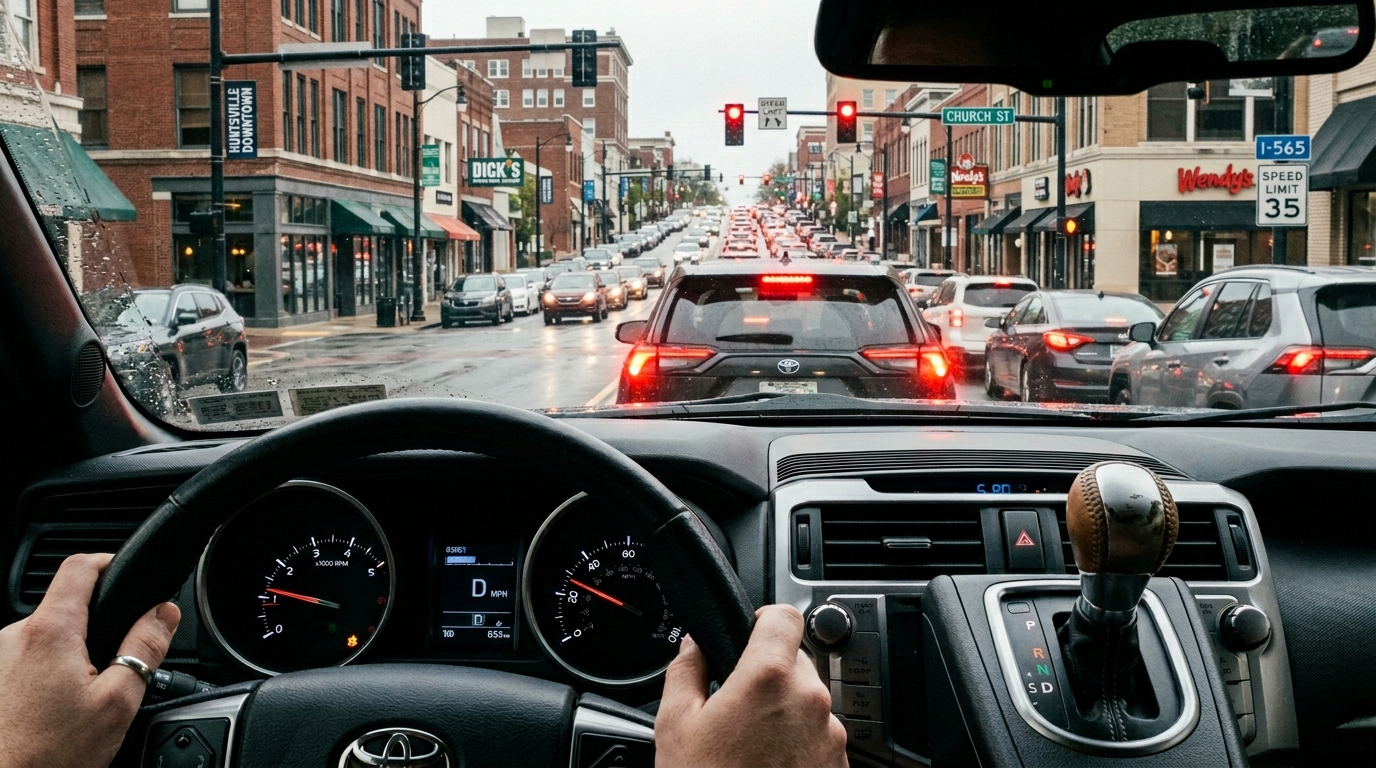
If you drive through Huntsville, Alabama, on a regular weekday, you already know the feeling. You inch along Memorial Parkway, brake at every light, and repeat the same stop-start dance for what feels like forever. It tests your patience for sure. But here is the thing most drivers never think about: while you sit in that traffic, your transmission is quietly taking a serious beating.
How Huntsville’s Traffic Creates a Unique Problem for Transmissions
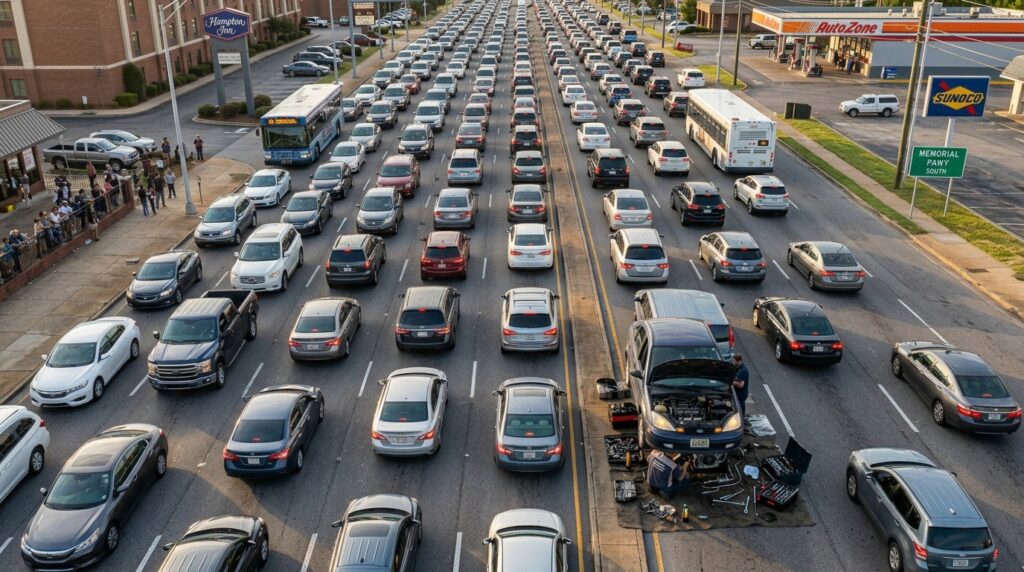
Huntsville is growing fast. Around 46,000 people commute to Redstone Arsenal every single day, and that number is expected to hit 50,000 by 2025.
Add in the workers heading to Cummings Research Park, which is home to around 300 companies, and you get massive traffic flow on roads like I-565, Highway 72, and Research Park Boulevard every morning and evening.
This kind of heavy commute traffic is not just annoying. It is classified by most car manufacturers as a “severe driving condition.” Your car was built to run most efficiently at steady highway speeds. When you are constantly stopping and starting, every system in your car works harder than normal and your automatic transmission takes the biggest hit.
I had a customer tell me once that he thought his transmission died because his car was “just old.” But when we looked at his driving habits, he was doing a two-hour round trip through downtown Huntsville traffic every single day for three years. That was the real story.
The Redstone Arsenal and Research Park Commute Adds Up Fast
Think about what a typical morning looks like. You leave home, merge onto I-565, slow to a crawl near the Redstone Arsenal gates, inch forward, brake again. Maybe you hit Airport Road or University Drive<span style=”font-weight: 400;”>, both of which see heavy flow during rush hour. The most congested time of day to travel into Huntsville from any direction is during the morning rush hour commute.
Every single time your car slows and speeds up again, your transmission shifts gears. In heavy traffic, this can happen hundreds of times in one commute. Hundreds of times of gear shifting, fluid pressure changes, and heat buildup. Over weeks and months, this wears things down much faster than highway driving ever would.
What Actually Happens Inside Your Transmission in Stop-and-Go Traffic
Heat Is the Number One Enemy
Here is the simple truth: heat kills transmissions. It is estimated that close to 90% of automatic transmission failures are caused by overheating, primarily from overworked transmission fluid.
That is a big number, and stop-and-go driving is one of the top reasons it happens.
Your transmission fluid has two jobs. It lubricates all the moving metal parts so they do not grind against each other. And it carries heat away from those parts to keep everything cool. A healthy transmission temperature stays at or below 175 degrees Fahrenheit. When the dashboard warning light comes on, showing transmission overheating, your vehicle is running at 250 degrees, which is considered an extremely high temperature.
When you are stuck on University Drive or crawling through the construction near Governors Drive, your engine is running, but you are barely moving. There is almost no airflow through the front of the car, so the cooling system cannot do its job the way it was designed to. Heat builds up. Fluid breaks down. And the damage starts.
Your Clutch Packs and Gears Are Working Overtime
Even if your car does not get dangerously hot, the constant gear shifting in traffic still wears things out faster. In both automatic and dual-clutch transmissions, internal clutch packs engage and disengage repeatedly in traffic conditions, which increases wear. Transmission fluid also deteriorates faster when exposed to high heat and frequent shifting cycles.
Think of it like this. If you open and close a door a thousand times a day instead of ten times, the hinges wear out sooner. That is exactly what is happening to the clutch packs inside your automatic transmission when you spend your commute in Huntsville’s bumper-to-bumper traffic.
Over time, this leads to slipping gears, harsh shifting, delayed acceleration, and eventually, a transmission that simply fails.
Warning Signs Your Huntsville Commute Is Hurting Your Transmission
Noises, Smells, and Slipping You Should Never Ignore
Honestly, a lot of people miss the early warning signs because they are easy to brush off. But your car is usually trying to tell you something before things get really expensive. Here is what to pay attention to:
A burning smell while you are in traffic is a big red flag. Overheated transmission fluid breaks down, reducing lubrication and increasing friction, and can lead to accelerated wear and tear, erratic shifting, and permanent damage requiring costly repairs or a full replacement. Mister Transmission That burnt smell is your fluid cooking. It means things are already too hot.
Gear slipping is another one. If your car feels like it hesitates before it actually moves when the light turns green, or if you notice it jumps or jerks between gears, your transmission is struggling. Delayed shifting, especially coming off a stop, is a sign that the internal components are worn or the fluid is breaking down.
Watch your dashboard warning lights too. A gear icon with a thermometer, or a message saying “transmission hot,” means your car is telling you directly to stop driving and let it cool down.
What Your Transmission Fluid Is Trying to Tell You
I always tell people: check your transmission fluid color. Fresh fluid is a clear red color. If you pull the dipstick and the fluid looks dark brown or black, or if it smells burnt, that fluid is no longer doing its job. It has been cooked by too many hot commutes.
According to a study by Mister Transmission, old or degraded fluid loses its cooling properties, leading to increased wear and tear. Regular maintenance, including fluid checks and replacements, helps maintain optimal transmission performance and reduces overheating risks.
Most people wait until the transmission actually fails before they think about the fluid. Do not make that mistake. A transmission fluid change is a cheap fix. A full transmission replacement in Huntsville can cost anywhere from $3,000 to $6,000 or more.
How to Protect Your Transmission if You Drive in Huntsville Traffic
Change Your Fluid More Often Than the Manual Says
Standard manufacturer advice usually says to change your transmission fluid every 60,000 to 100,000 miles. But that number was not written with daily Huntsville stop-and-go commuting in mind. If you live and drive your vehicle in a hot climate or find yourself engaging in lots of stop-and-go traffic, it is advisable to change your transmission fluid every 15,000 to 20,000 miles to ensure it remains fresh and effective.
If you are doing the Redstone Arsenal commute on I-565 five days a week, or spending your mornings crawling along University Drive, you are in that severe driving category. More frequent fluid changes are not optional for you; they are necessary.
I know it sounds like an extra expense. But think about it this way: a fluid change costs maybe $100 to $200. A full transmission repair costs thousands. There is no comparison.
Consider a Transmission Cooler and Smarter Driving Habits
One thing that really helps for drivers who spend a lot of time in traffic is an auxiliary transmission cooler. Most are designed to work in tandem with the manufacturer’s original transmission cooler, and they provide increased fluid capacity so that more heat will be removed faster. Transmission Repair Cost Guide: It is a relatively affordable add-on that can make a real difference if your daily drive looks like the I-565 rush hour.
On the driving side, small habit changes help too. Try to leave a bigger gap between you and the car in front of you. This lets you slow down and speed up more gradually instead of hard stops and fast starts. Avoid aggressive acceleration every time traffic clears up for a few seconds. Smooth driving means less gear shifting, less heat, and a longer life for your transmission.
According to AutoNation Mobile Service, heavy acceleration, hard braking, and stop-and-go traffic can all raise internal temps and trigger the transmission warning light. Preventing transmission overheating is simple and far less expensive than fixing the potential damage it can cause.
H3: Get Your Transmission Inspected Regularly
If you have been driving through Huntsville traffic for a year or more without a transmission check, now is a good time. A good transmission shop will check your fluid level and condition, look for any leaks, and run a diagnostic to catch problems early.
The difference between a $200 service appointment and a $5,000 transmission replacement is usually just time. Catch a problem early, and it is a small fix. Ignore it until you are stranded on Research Park Boulevard during rush hour, and it becomes a very expensive day.
Do not wait for the smoke or the burning smell. Be proactive about it.
Conclusion
Huntsville’s stop-and-go traffic is not going anywhere. In fact, as the city keeps growing and more people pour into the Redstone Arsenal and Cummings Research Park corridors, the congestion is only going to get worse. That means every driver in North Alabama needs to think about their transmission health the same way they think about oil changes.
The damage from stop-and-go driving is real, and it adds up slowly. Heat builds. Fluid breaks down. Clutch packs wear out. And one day, without warning, your transmission fails in the worst possible moment. The good news is that this is completely preventable with regular fluid changes, smarter driving habits, and periodic inspections.
Your car can handle Huntsville traffic. You just have to give it the help it needs.
Frequently Asked Questions
How does Huntsville’s stop-and-go traffic damage transmissions?
Every time you stop and start in traffic, your transmission has to shift gears and manage heat. In heavy Huntsville traffic like the I-565 corridor or near Redstone Arsenal, this can happen hundreds of times per commute. The constant shifting and lack of airflow cause heat to build up inside the transmission. Over time, this breaks down the transmission fluid and wears out internal parts like clutch packs and gear bands, leading to slipping, harsh shifts, and eventually full transmission failure.
How often should I change my transmission fluid if I commute in Huntsville?
If you are commuting daily through heavy traffic in Huntsville, you should change your transmission fluid much more often than the standard recommendation. For severe driving conditions like stop-and-go traffic, every 15,000 to 20,000 miles is a smart interval. Fresh fluid keeps your transmission cooler and protects the internal parts far better than old, dark fluid that has been cooked by heat.
What are the early signs that my transmission is being damaged by traffic?
The earliest signs include a burning smell while sitting in traffic, a slight delay or hesitation when accelerating from a stop, the transmission slipping between gears, or harsh and jerky gear changes. You might also see a dashboard warning light showing a thermometer near a gear icon. If you notice any of these, have your transmission checked right away before the problem gets worse.
Is an auxiliary transmission cooler worth it for Huntsville drivers?
Yes, for people who drive in heavy traffic every day, an auxiliary transmission cooler is a smart investment. It gives your cooling system more capacity to remove heat from the transmission fluid, which is exactly what you need when you are idling in slow traffic on University Drive or Airport Road. It works alongside your existing cooler and helps keep temperatures at a safe level even during long, slow commutes.
Can I do anything differently while driving in traffic to protect my transmission?
You can make a real difference with small habit changes. Leave extra space between you and the car ahead so you can ease off the gas gradually instead of stopping hard every few seconds. Avoid punching the accelerator every time a gap opens up. Smooth, steady driving puts much less strain on your transmission than aggressive stop-and-go behavior. Also, if you are sitting still for a long time in gridlock, shifting into neutral can take some load off the transmission while you wait.