
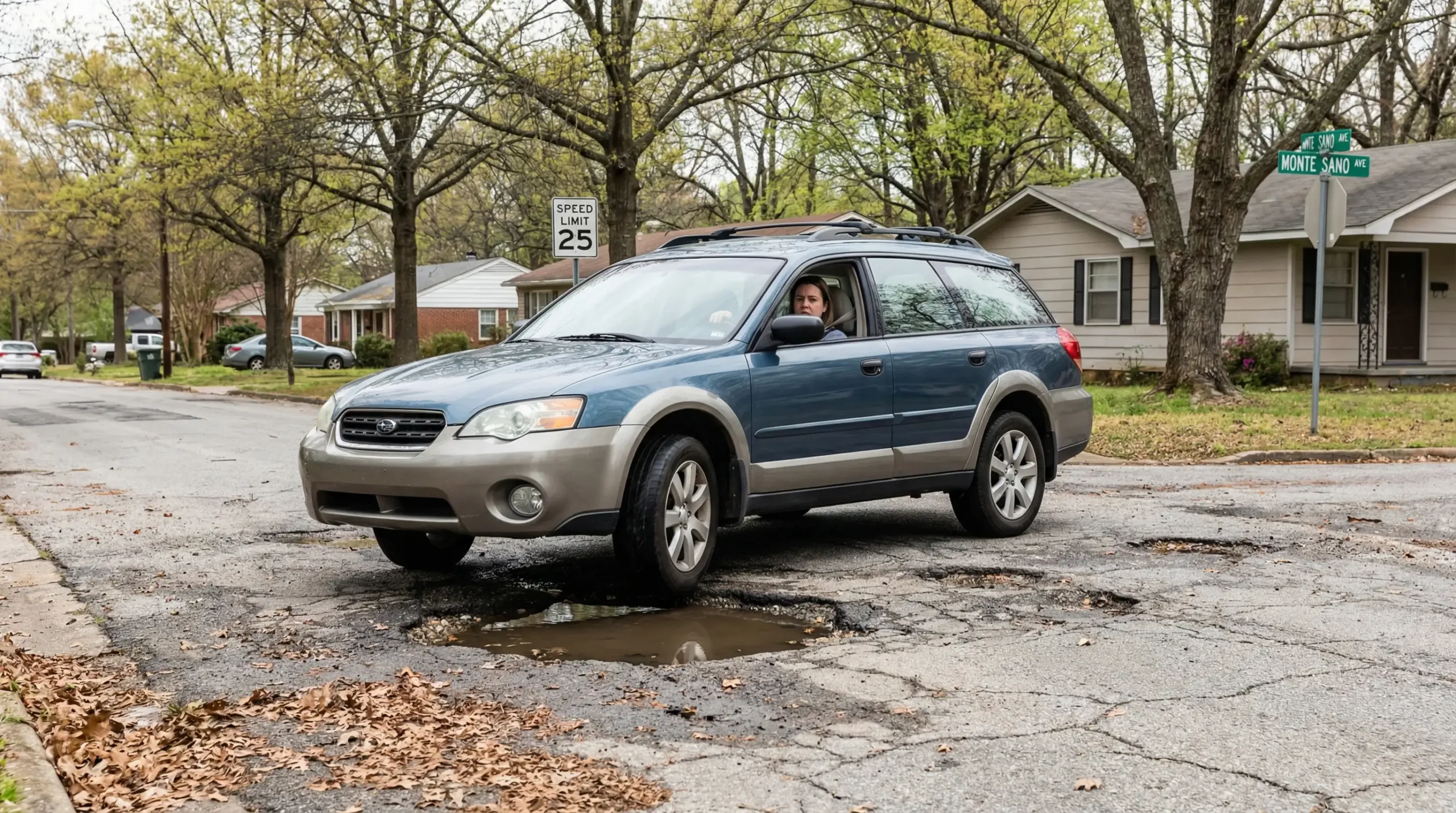
Did you hit a pothole yesterday and now your car feels weird? Maybe it pulls to the left. Maybe you hear a clunk when you go over bumps.
You’re not alone. I see this all the time here in Huntsville.
Potholes are everywhere on our roads. And they don’t just hurt your tires—they can mess up your whole suspension system and throw your alignment completely off. The worst part? Sometimes you won’t feel the damage right away. It shows up days or even weeks later.
Let me help you figure out what’s going on with your car and what you should do next.
How Potholes Quietly Damage Your Suspension (Even When You Don’t Feel It)
What Happens Inside Your Car When You Hit a Pothole
When your tire drops into a pothole, it’s like your car just fell off a tiny cliff.
The impact travels up through your wheel, into your suspension, and all the way to your steering system. Your car is built to handle normal bumps. But a deep pothole? That’s different.
Here’s what happens in less than a second:
Your tire hits the edge. The shock absorbers try to catch the impact. But if the pothole is deep, they can’t do it fast enough. The force moves to other parts like control arms, ball joints, and struts.
Sometimes these parts bend. Sometimes they crack. And sometimes they look fine, but stop working the way they should.
I once hit a pothole on University Drive. Didn’t think much of it. Two weeks later, my car started pulling to the right every time I let go of the wheel. Turned out the pothole had knocked my wheel alignment off by just a few degrees. Small change, big problem.
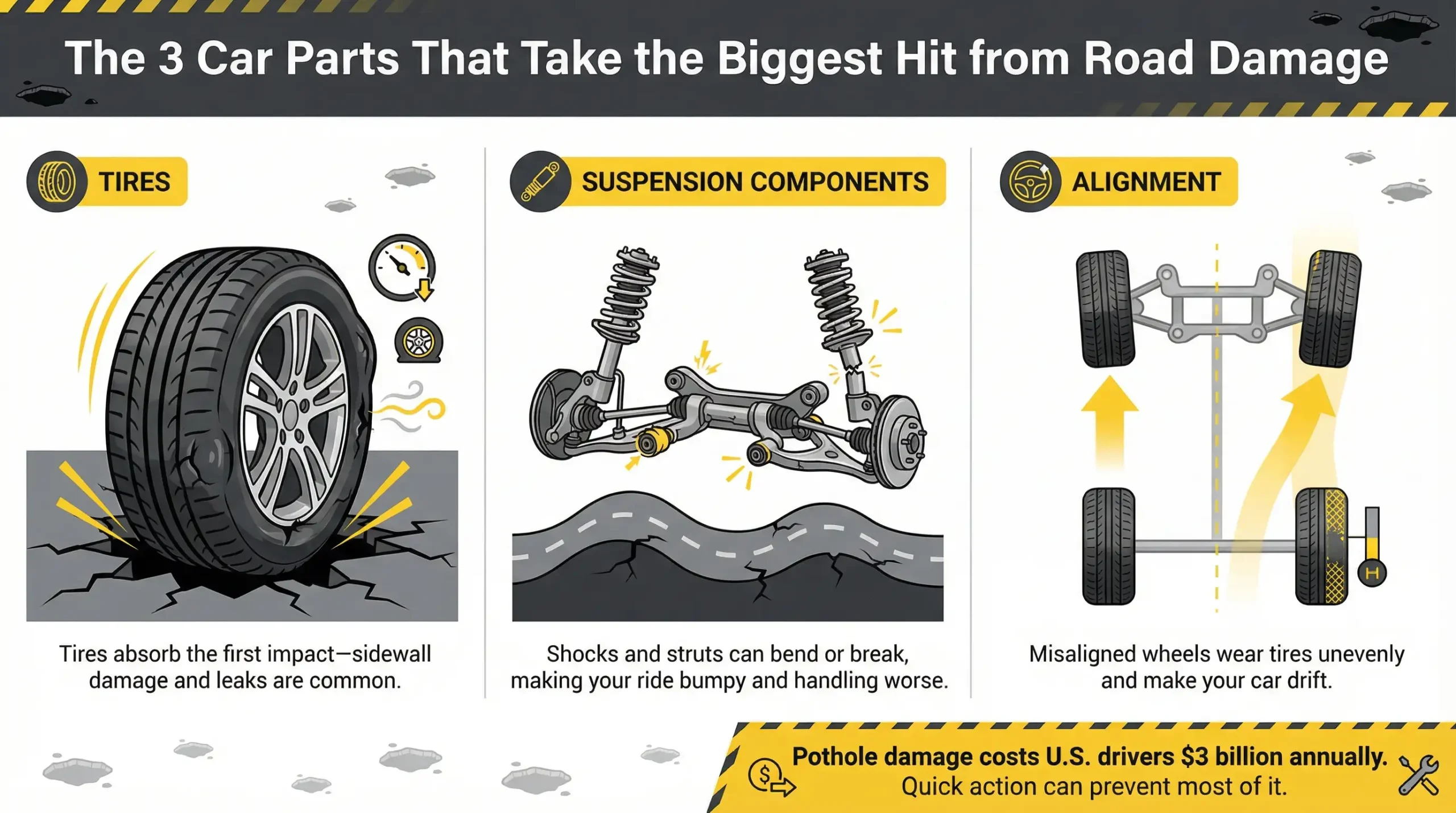
The 3 Car Parts That Take the Biggest Hit from Road Damage
Not all car parts get hurt the same way by potholes. Three parts take most of the beating:
Your tires. They hit first, so they suffer first. Potholes can cause sidewall bulges, cuts, or even a slow leak you don’t notice until your tire pressure is way too low.
Your suspension components. Things like shocks, struts, bushings, and control arms are meant to absorb hits. But potholes can bend or break them. Once that happens, your ride gets bumpy and your car handling gets worse.
Your alignment. This one’s tricky because you can’t see it. Your wheels need to point in exactly the right direction. A pothole can push them out of place. When that happens, your tires wear out fast on one side and your car drifts when you drive straight.
According to a study by the American Automobile Association (AAA) pothole damage costs U.S. drivers about $3 billion every year in vehicle repairs. That’s a lot of money. And most of it could be avoided with quick action.
Warning Signs Your Car Needs Suspension Repair After Pothole Damage
Your Steering Wheel Pulls to One Side While Driving
This is the number one sign that something’s wrong.
You’re driving down a straight road. Hands barely touching the wheel. And your car keeps drifting left or right.
That’s not normal. It means your alignment is off.
When you hit a pothole, it can knock your wheels out of their correct angle. Even a tiny shift—like half a degree—can make your car pull to one side.
This isn’t just annoying. It’s dangerous. Your tires will wear out fast. Your fuel efficiency drops because your engine has to work harder to keep the car straight. And if you’re not paying attention, you could drift into another lane.
I’ve seen people ignore this for months. By the time they come in, their tires are bald on one side and they need to buy a whole new set. Don’t let that be you.
Strange Noises When You Drive Over Bumps
If you hear clunking, rattling, or creaking when you go over bumps, your suspension might be damaged.
These sounds mean something is loose or broken. Maybe a bushing cracked. Maybe a shock absorber is leaking fluid. Maybe a ball joint came loose.
Whatever it is, it’s not going to fix itself.
I remember one time my neighbor kept hearing a weird noise every time she backed out of her driveway. She thought it was nothing. Turns out, a pothole had broken one of her struts. When it finally gave out completely, her car dropped on one side and she couldn’t drive it.
Don’t wait for that to happen. If you hear strange sounds, get it checked.
What Is Suspension Repair and Why Does It Matter?
How Your Suspension System Actually Works
Your suspension system is like a cushion between your car and the road.
It’s made up of springs, shocks, struts, and other parts that work together. When you drive over a bump, these parts absorb the hit so you don’t feel it as much inside the car.
But it does more than just make your ride smooth. It also keeps your tires on the road. Good tire contact means better braking, better turning, and better control.
When your suspension is broken, everything feels off. The car bounces too much. It leans hard when you turn. It takes longer to stop.
Your suspension also affects how long your tires last. If your car is sitting crooked because of bad shocks or struts, your tires will wear out unevenly. You’ll end up buying new tires way sooner than you should.
Common Suspension Parts That Break from Potholes
Let me walk you through the parts that usually get damaged:
Shocks and struts. These absorb the up-and-down motion when you drive. A bad pothole can bend them or make them leak fluid. When they’re broken, your car bounces a lot and feels unstable.
Control arms. These connect your wheels to the car frame. They can bend if you hit a pothole hard enough. Bent control arms mess up your alignment and make steering feel loose.
Ball joints. Think of these like the hinges that let your wheels move up and down and side to side. A pothole can crack them. When they break, you’ll hear clunking and your car might pull to one side.
Bushings. These are small rubber parts that cushion the metal pieces in your suspension. Potholes can tear them. Once they’re torn, metal rubs on metal and you hear creaking or rattling.
All of these parts are important. If even one breaks, your whole suspension system doesn’t work right.
Car Alignment Services Near You in Huntsville, AL
What Happens During a Professional Wheel Alignment
When you bring your car in for an alignment, here’s what happens:
First, a mechanic puts your car on a special machine. This machine has sensors that measure the angles of your wheels.
There are three main angles they check: camber, caster, and toe.
Camber is how much your wheel tilts in or out when you look at it from the front. Caster is the angle of your steering from the side. Toe is whether your wheels point straight or if they angle in or out when you look from above.
The machine compares your car’s angles to what the manufacturer says they should be. If anything is off, the mechanic adjusts it using special tools.
The whole process takes about an hour. When it’s done, your car should drive straight and your tires should wear evenly.
According to Midas, proper alignment can extend tire life by up to 12,000 miles.That’s a big deal if you’re trying to save money.
How Often Should You Get Your Car Aligned?
Most experts say you should check your alignment once a year.
But if you hit a lot of potholes, you might need it more often. I’d say every 6,000 to 10,000 miles is a good rule.
You should also get it checked anytime you notice your car pulling to one side or if you see uneven tire wear.
Some people wait until their tires are completely worn out. By then, it’s too late. The damage is done and they have to spend hundreds of dollars on new tires.
Don’t be that person. A simple alignment costs way less than a new set of tires.
How Much Does Suspension Repair Cost in Huntsville?
Average Costs for Shocks, Struts, and Alignment
Let’s talk about money. I know that’s probably what you’re worried about.
Here are some rough prices you can expect in Huntsville:
Wheel alignment: Usually between $75 and $150. Some shops charge more if your car needs extra adjustments.
Shocks or struts replacement: This depends on your car, but expect $300 to $700 per axle. That includes parts and labor.
Control arm replacement: Around $200 to $500 per side.
Ball joint replacement: About $150 to $400 per joint.
These are just estimates. Your actual cost depends on what’s broken and what kind of car you drive.
But here’s the thing: Fixing it now is always cheaper than waiting. If you ignore a bad shock, it can damage other parts. Then you’re paying for multiple repairs instead of just one.
Can I Drive with Bad Suspension? (The Real Answer)
Technically, yes. Your car will still move.
But should you? No.
Driving with bad suspension is dangerous. Your car doesn’t handle right. It takes longer to stop. It’s harder to control in turns. If a strut or shock is really bad, your car might bottom out when you hit a bump.
I’ve seen people drive around for months with broken suspension. They think they’re saving money. But then they get in an accident because their car couldn’t stop in time, or they blow a tire because of uneven wear.
It’s not worth the risk. If something feels wrong, get it checked. Most shops will do a free inspection and tell you what’s going on.
Choosing the Right Auto Shop for Suspension Repair in Huntsville
What to Look for in a Trusted Mechanic
Not all mechanics are the same. Here’s what I look for when I need suspension repair:
Experience. You want someone who’s done this kind of work before. Ask how long they’ve been fixing suspensions.
Certifications. Look for ASE-certified technicians. That means they passed tests and know what they’re doing.
Equipment. Good alignment requires special machines. Make sure the shop has up-to-date diagnostic equipment.
Transparency. A good mechanic will explain what’s wrong in simple words. They’ll show you the problem and give you options. They won’t pressure you into repairs you don’t need.
Warranty. Ask about their warranty. Some shops offer a 12-month or 12,000-mile warranty on parts and labor.
I once went to a shop that seemed cheap. They “fixed” my alignment but didn’t actually replace anything. Two weeks later, the problem came back. I had to pay someone else to do it right.
Don’t make that mistake. Find a shop you can trust.
Questions to Ask Before Getting Your Car Fixed
Before you agree to any work, ask these questions:
What exactly is broken? Don’t just accept “you need suspension work.” Ask them to name the specific parts.
How much will it cost? Get a written estimate before they start.
Do you have a warranty on the work? Make sure it’s in writing.
How long will it take? Most suspension jobs can be done in a few hours. If they say it’ll take days, ask why.
Can I see the broken parts? A good shop will show you what’s wrong, either in person or with pictures.
These questions help you avoid getting ripped off. They also help you understand what’s happening with your car.
Conclusion
Potholes are a pain. They’re all over Huntsville roads, and they’re not going away.
But now you know what to look for. If your car pulls to one side, makes weird noises, or just doesn’t feel right after you hit a pothole, don’t ignore it.
Get your suspension and alignment checked. It’s cheaper to fix it now than to wait until something breaks completely.
Your car is important. It gets you to work, to the store, to see your family. Take care of it, and it’ll take care of you.
If you’re dealing with any of these issues, find a good auto shop near you in Huntsville, AL. Ask questions. Get it checked. And drive safe out there.
Frequently Asked Questions (FAQs)
How do I know if my suspension is damaged?
Look for these signs: your car pulls to one side, you hear clunking or rattling over bumps, your ride feels bouncy, or you see uneven tire wear. If you notice any of these, your suspension might be damaged. Get a mechanic to check it. Most shops will do a free inspection.
Can hitting one pothole mess up my alignment?
Yes, it can. Even one big pothole can knock your wheels out of alignment. You might not feel it right away, but over time you’ll notice your car pulling to one side or your tires wearing unevenly. If you hit a deep pothole, it’s smart to get your alignment checked soon after.
Is suspension repair covered by car insurance?
Usually, no. Most car insurance doesn’t cover wear and tear or damage from potholes. But if the pothole damage happened because of a car accident, your insurance might cover it. Check your policy or call your insurance company to be sure. Some cities also have programs where you can file a claim for pothole damage.
How long does suspension repair take?
It depends on what needs to be fixed. A simple wheel alignment takes about an hour. Replacing shocks or struts can take 2 to 4 hours. Bigger jobs like replacing control arms or multiple parts might take a full day. Your mechanic should give you a time estimate when you drop off your car.
What happens if I ignore suspension problems?
Ignoring suspension problems makes them worse. Your tires will wear out faster because they’re not sitting flat on the road. Your car will be harder to control, especially in bad weather. Your fuel efficiency drops because your engine works harder. And eventually, something will break completely, leaving you stuck on the side of the road with a bigger repair bill. Fix it early, save money later.