
Your car starts shaking more than usual. You hear a clunk from under the hood every time you shift gears. Most people brush it off and keep driving. But that clunk and that shake? They could be engine mount replacement signs your car is trying to warn you about. And the longer you wait, the worse and more expensive it gets.
What Is an Engine Mount and Why Does It Matter?

The Simple Job These Small Parts Do
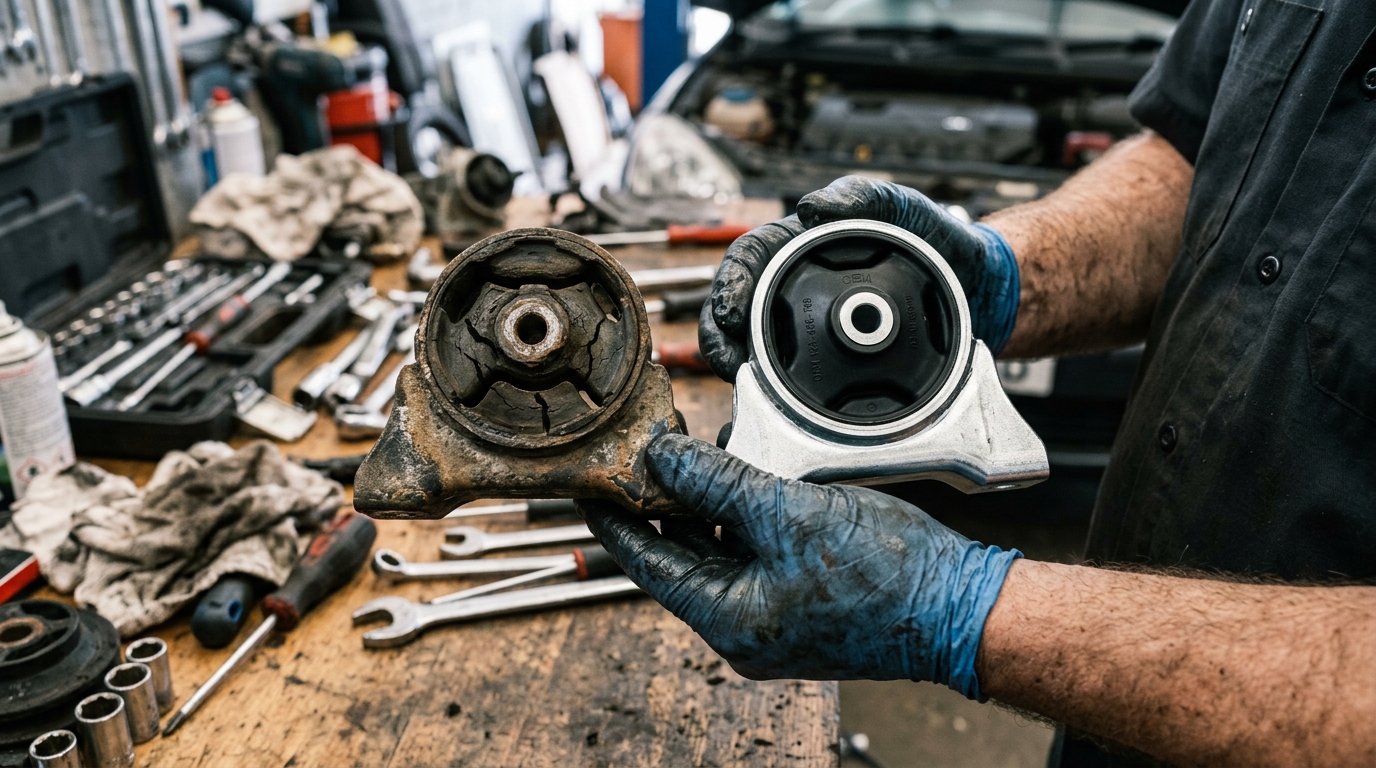
An engine mount, also called a motor mount, is a small but very important part. It connects your engine to your car’s frame. Most cars have two to four of them. They are made of metal and rubber. The metal holds everything together. The rubber soaks up the shaking and noise from the engine so you don’t feel it inside the car.
Think of it this way. Your engine spins and shakes all the time. Without engine mounts, all that movement would go straight into your seat, your hands, and the whole car body. The mounts take the hit for you.
They also keep the engine in the right spot. If the engine moves too much, it can pull on hoses, belts, the exhaust system, and even the transmission. So yes, these small parts do a very big job.
How Long Do Engine Mounts Last?
I get this question a lot, and the answer is: it depends. On average, engine mounts last between 5 to 7 years or about 60,000 to 100,000 miles. But driving habits, road conditions, and oil leaks can shorten that life fast.
There is no fixed replacement schedule for most cars. You just watch for the signs. That’s exactly what we’re going to cover next.
7 Engine Mount Replacement Signs You Should Know
Sign 1: Excessive Vibration Inside the Cabin
One of the first and most common engine mount replacement signs is feeling too much vibration. You might feel it through the steering wheel, your seat, or even the floorboard. It’s usually worst at idle or when you speed up.
When a motor mount wears out, it loses its ability to soak up the engine’s movement. The rubber inside may crack, harden, or the fluid-filled mount may start to leak. Once that happens, the vibration dampening stops working, and all that shaking travels straight into the cabin.
Honestly, this is the sign most drivers notice first but think is normal. It’s not. If your car is shaking more than it used to, don’t ignore it.
Sign 2: Clunking or Thumping Noises
If you hear a loud clunking or thumping noise from the engine bay when you shift gears, speed up, or slow down, that’s a red flag. This happens because a worn motor mount can no longer hold the engine in place. The engine moves too much and hits nearby parts inside the engine bay.
These impact noises are easy to confuse with transmission issues or suspension problems. But if the sound comes mostly when shifting or during quick acceleration, the engine mount is usually the first thing to check.
I once had a customer come in thinking his car had a broken transmission. Turns out it was just one bad motor mount. A quick fix saved him hundreds of dollars.
Sign 3: Engine Lurching Forward at Start or Stop
Does your engine lurch forward when you turn the key? Or does it jump when you turn the engine off? That’s a very clear sign of motor mount failure. When the engine mount loses its stiffness, the engine torque causes the engine to jolt forward or backward without anything to stop it properly.
This kind of movement is not normal. The engine should sit firmly in place. If you feel it rocking around, especially at startup or shutdown, it’s time to get the motor mount checked right away.
Sign 4: Unusual Engine Movement When You Rev the Engine
Here’s a quick test you can do yourself. Open the hood with the engine running. Have someone rev the engine a little while you watch the engine from a safe distance. A small amount of movement is normal. But if the engine rocks, tilts, or moves a lot, your engine mounts are probably worn out.
When the rubber inside a mount breaks down or the bonding fails, the mount can’t keep the engine from moving. This engine movement or engine misalignment can stretch wiring harnesses, pull on fuel lines, and damage drive belts over time.
Sign 5: Visible Cracks, Corrosion, or Fluid Leaks
Sometimes your eyes tell you everything you need to know. If you peek under the hood and see that an engine mount looks cracked, bent, corroded, or warped, it’s already past the point of warning. Rubber that has cracked has lost most of its ability to absorb shocks.
If you have a hydraulic mount or fluid-filled mount, look for any wet spots or stains around it. Once that fluid leaks out, the mount loses almost all of its vibration dampening ability. Any leak from a hydraulic mount means you need to replace it, not patch it.
Also look for oil stains on the rubber. According to Autoscope Car Care, oil that drips onto rubber mounts eats away at the material and causes premature failure. So fix any oil leak fast.
Sign 6: Rough or Jerky Gear Changes
This one is easy to miss because people usually blame the transmission. But if your gear changes feel rough, jerky, or delayed, a worn engine mount could be behind it. When the engine isn’t held firmly in place, it shifts slightly during gear changes. That movement makes the shift feel rough even when the transmission itself is fine.
Before spending big money on a transmission repair, always ask your mechanic to check the engine mounts first. It’s a much cheaper fix and often the real cause.
Sign 7: Broken Clips, Brackets, or Wear Patterns
Look closely at the area around the engine mount. If you see broken clips, bent brackets, rubbing marks, or unusual wear patterns on nearby parts, the engine has been moving too much for too long. This kind of damage tells you the mount has already failed and the engine is bouncing around in the engine compartment.
At this point, you need to act fast. A completely broken motor mount can let the engine contact the fan, the shroud, or the firewall. That leads to very expensive secondary damage.
What Causes Engine Mounts to Fail?
Age and Normal Wear
The most common cause is simply age. The rubber inside a motor mount gets hard and brittle over time. Heat cycles from the engine, cold weather, and constant movement all slowly break the rubber down. After 5 to 7 years, most mounts start showing signs of rubber degradation. This is expected.
Oil Leaks and Fluid Contamination
Oil or transmission fluid dripping onto an engine mount speeds up the breakdown a lot. The chemicals in engine oil attack the rubber body of the mount and make it soft, weak, and brittle much faster than normal age would. This is why fixing any fluid leak quickly protects your mounts and saves you money in the long run.
Rough driving on bad roads, heavy loads, and hard stops also put extra stress on the mounts and shorten their life. Driving habits matter more than most people think.
Engine Mount Replacement Cost: What to Expect
Parts and Labor Breakdown
The cost to replace an engine mount varies quite a bit. Simple rubber engine mounts for regular cars can cost as little as $10 to $150 for the part alone. More complex hydraulic mounts or active motor mounts can run $150 to $600 or more per mount.
Labor is usually the biggest part of the bill. Most replacements take 2 to 4 hours of mechanic time. According to RepairPal, the average total cost for engine mount replacement is between $607 and $747 depending on your car and location. If you need multiple mounts replaced, the total can go up to $1,500 or more.
| Mount Type | Part Cost | Total with Labor |
| Standard rubber mount | $10 – $150 | $200 – $500 |
| Hydraulic / fluid-filled mount | $150 – $600 | $500 – $1,200 |
| Active motor mount | $300 – $600+ | $700 – $1,500+ |
| All mounts replaced together | Varies | $600 – $1,500+ |
Source: RepairPal.com and JD Power
Should You DIY or Go to a Mechanic?
Replacing an engine mount yourself is possible if you have good tools and some experience. You’ll need an engine support bar or floor jack to hold the engine safely while you remove the old mount. The process involves unbolting the old mount, lowering or lifting the engine slightly, and bolting in the new one.
But here’s the honest truth: if you don’t know what you’re doing, this is not the repair to learn on. The engine is very heavy. Supporting it wrong can cause serious damage or injury. For most people, going to a professional mechanic is the safer choice. The savings from DIY aren’t worth the risk if things go wrong.
When choosing replacement parts, go for OEM parts or high-quality aftermarket mounts that meet factory specs. Cheap budget parts might save you $20 today but fail again in a year.
What Happens If You Ignore Bad Engine Mounts?
Small Problem, Big Bill
Ignoring engine mount replacement signs is one of the most expensive mistakes a car owner can make. When a motor mount fails, the engine can move so much that it contacts the fan or shroud, damaging both. The wiring harness can stretch and break. Fuel lines and hydraulic hoses can crack. The exhaust system can pull apart.
All of these repairs together could cost thousands. Compare that to a single motor mount replacement at $300 to $700. The math is not hard. Fix it early.
Safety Risks You Shouldn’t Take
A broken engine mount is also a safety hazard. If the mount breaks completely, parts can shift or fly off in ways that affect how the car steers and brakes. That’s not just a repair problem. That’s a risk to you and everyone on the road around you.
Routine maintenance and visual inspection of your engine mounts, especially after high mileage or a rough winter, can catch problems before they become dangerous.
Conclusion
Knowing the engine mount replacement signs early can save you a lot of money and stress. Watch for too much vibration, strange clunking noises, engine lurching, rough gear changes, or visible cracks in the mount. These are your car’s way of telling you something is wrong before it gets worse.
Don’t wait until the repair bill doubles or triples. A worn motor mount is one of the most affordable fixes you can make if you catch it early. Get it checked, get it fixed, and drive with peace of mind.
Have you noticed any of these signs in your own car? I’d love to hear your experience in the comments below.
Frequently Asked Questions
How do I know if my engine mount needs to be replaced?
Look for these clear engine mount replacement signs: too much vibration inside the car, a clunking noise when shifting gears, the engine lurching at startup or shutdown, visible cracks or corrosion on the mount, or rough gear changes. If you notice any two of these at the same time, have a mechanic check the mounts right away.
Can I drive with a bad engine mount?
You can drive a short distance to a repair shop, but driving with a bad motor mount for a long time is risky. The engine can move too much and damage hoses, belts, the exhaust system, and even the transmission. It also becomes a safety hazard if the mount breaks completely. Get it fixed as soon as you can.
How long does an engine mount replacement take?
Most engine mount replacements take between 2 and 4 hours at a repair shop. Some vehicles with tight engine compartments or load-bearing mounts can take longer because the mechanic needs to remove other parts to reach the mount. Simple non-load-bearing mounts are much faster to replace.
What is the average engine mount replacement cost in 2025-2026?
According to RepairPal, the average cost is between $607 and $747 for a single engine mount, including labor. Simple rubber mounts on budget cars cost less (around $200 to $400 total). Complex hydraulic mounts on newer cars can cost $700 to $1,200 or more. Labor accounts for roughly 50% to 70% of the total bill.
How many engine mounts does a car have?
Most cars have two to four engine mounts. The number depends on the make and model of the vehicle. Some cars also have a separate transmission mount that does a similar job for the gearbox. If one mount fails from age, it’s often worth checking the others too, since they have gone through the same amount of use and wear.