

The cost of ignoring timing belts is not just money. It is your whole engine. One small rubber belt keeps your car alive, and when it snaps, everything can fall apart in seconds. No warning. No second chance. Just a very big repair bill.
What Is a Timing Belt and Why Should You Care?
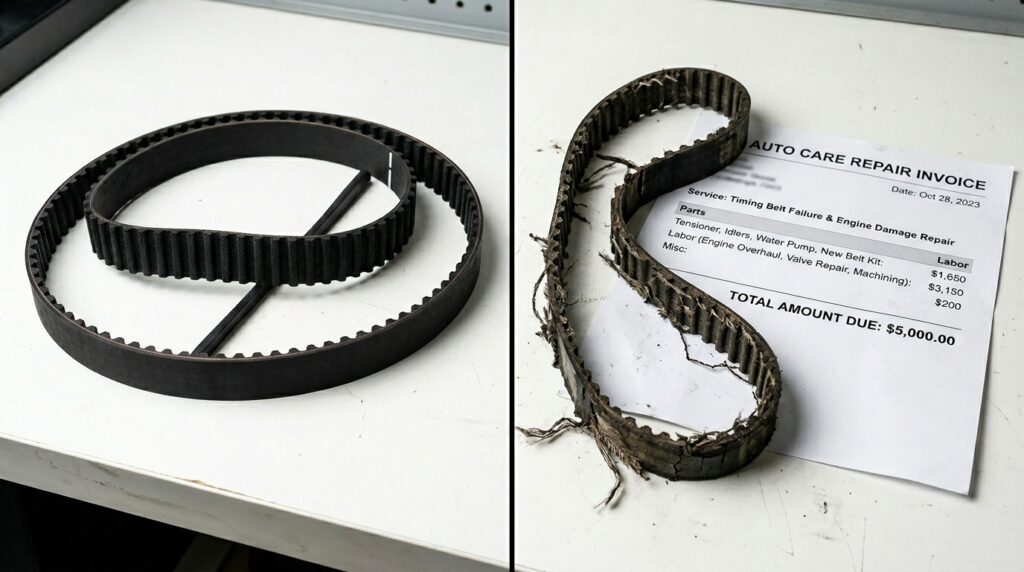
Most drivers have never seen their timing belt. It sits deep inside the engine, hidden under a plastic cover. You cannot check it by simply lifting the hood. And because you cannot see it, many people forget it even exists until it is too late.
But here is the truth. Without this belt, your engine cannot run at all.
How the Timing Belt Keeps Your Engine Running
Your engine has two main spinning parts: the crankshaft and the camshaft. The crankshaft moves the pistons up and down. The camshaft opens and closes the engine valves at just the right moment during each intake stroke and exhaust stroke.
The timing belt connects these two parts and keeps them moving together in perfect sync. Think of it like a drummer keeping the whole band on beat. If the drummer stops, everything falls apart.
Your timing belt is a rubber belt with teeth cut into it, those teeth grip sprockets on both the crankshaft and camshaft. As long as the belt holds, the engine runs smoothly and cleanly. The moment it snaps, the engine falls completely out of sync.
Interference Engine vs Non-Interference Engine: The Key Difference
Not every car reacts the same way when a timing belt breaks. This is where the type of engine matters a lot.
In a non-interference engine, the engineers built extra space between the pistons and valves. So even if the belt breaks, the parts do not hit each other. Your car will still stop, but the engine itself will likely be okay. You can replace the belt and drive again.
But in an interference engine, there is zero clearance between the pistons and valves. They share the same space at different times. The belt is the only thing keeping them from smashing into each other. If the belt goes, the pistons and valves collide at high speed.
About 70% of cars on the road today have interference engines. Popular models from Honda, Toyota, Subaru and Volkswagen all use them. If you drive one of these, a snapped timing belt is not just an inconvenience. It is a disaster.
What Happens When a Timing Belt Breaks?
I remember talking to a driver at a shop a few years back. He was calm when he walked in, but pale by the time the mechanic showed him the damage. He had just missed his replacement interval by about 15,000 miles. That choice cost him dearly.
The Chain Reaction Inside Your Engine
When a timing belt snaps, everything happens fast. The crankshaft keeps spinning for a split second from leftover momentum. But the camshaft suddenly stops. The valves that were open stay open. And the pistons keep moving up.
In an interference engine, those pistons slam into the open valves at full force. The result is bent valves, damaged pistons and sometimes a cracked cylinder head. The damage usually spreads fast. By the time the engine stops, several parts are already destroyed.
Your car will not just stall. It will stop completely. Right there on the road. You will need a tow truck and then face a mechanic telling you news you really do not want to hear.
Can a Broken Timing Belt Destroy Your Engine?
Yes. A broken timing belt in an interference engine can destroy the engine completely. This is not an exaggeration.
After the collision between the pistons and valves, the mechanic must remove the valve cover and sometimes the entire cylinder head just to see how bad it is. The full damage is often worse than expected. Broken valve stems, cracked pistons, a damaged camshaft. Some engines are so far gone that the only real option is a full engine rebuild or a complete engine replacement.
This is why people say catastrophic failure when they talk about timing belt breaks. Because that is exactly what it is.
Warning Signs of a Failing Timing Belt
Here is the honest and difficult part. Timing belt failure often happens with no warning at all. But not always. There are a few signs you should know.
Common Symptoms Drivers Often Ignore
The most common sign is a ticking noise coming from under the hood. This happens when the belt is loose or the tensioner is starting to fail. Many drivers hear it and assume it is nothing serious.
Other signs include a rough idle, difficulty starting the car and a drop in power when you accelerate. If the belt has slipped slightly, it can throw off the engine timing just enough to cause misfires and poor fuel efficiency.
You might also notice oil around the timing belt cover. Oil leaks from worn gaskets can soak into the rubber belt and break it down faster. This speeds up wear in a way you will never see from the outside.
If your car is shaking at idle, stalling for no reason or struggling to start on cold mornings, get it checked. These are signs your engine is not running in proper sync.
Why Your Belt Can Snap With Zero Warning
Here is what makes the timing belt different from most car parts. It does not usually warn you before it breaks. It just snaps. One second you are driving normally, the next second your engine is silent.
Unlike brake pads that squeal or tires that wobble, a timing belt is made of rubber. Rubber degrades from the inside out due to heat, age and stress. You cannot always see cracks forming. The belt can look okay on the outside while being dangerously weak inside.
This is exactly why following your replacement interval is so important. You cannot rely on the belt to tell you it is tired.
When Should You Replace Your Timing Belt?
This question has a simple answer. Check your owner’s manual. That is always the first place to look.
The Right Replacement Schedule to Follow
Most car makers recommend replacing the timing belt every 60,000 to 100,000 miles. Some older models call for it at 90,000 or 105,000 miles. The exact number depends on your car’s make, model and engine design.
But mileage is not the only thing that matters. Age matters too. If your car has low miles but is more than 5 to 7 years old, the belt can still be weak. Rubber breaks down over time even if the car is not driven much. Heat cycles, moisture and time all take a toll.
A good rule to follow: if you bought the used car and you are not sure when the belt was last changed, get it inspected right away. Do not assume the previous owner kept up with it.
Other Parts You Should Replace at the Same Time
Here is a tip that can save you a lot of money later. When you replace your timing belt, replace the tensioner and idler pulleys at the same time. These parts are right next to the belt. They wear out at about the same rate.
If a tensioner fails after a fresh belt replacement, you will have to pay for all that labor again. That is a painful bill for a simple oversight.
Many mechanics also recommend replacing the water pump at the same time. On most vehicles, the water pump is driven by the timing belt and is located right behind the cover. Replacing it during the same service adds very little extra labor cost. But if you skip it and the water pump fails six months later, you will pay the full labor cost all over again to access it.
Think of it as getting the most out of one visit. According to data published by AutoZone, a full timing belt kit including the belt, 2-3 idler pulleys and the tensioner typically costs between $100 and $350 in parts.
Timing Belt Replacement Cost vs Engine Repair Cost
This is where the numbers make the decision very easy.
How Much Does It Cost to Replace a Timing Belt?
A timing belt replacement typically costs between $500 and $1,285 depending on your car’s make and model. Labor usually takes between 3 and 6 hours. Labor costs are the biggest part of the bill because the belt is buried deep inside the engine and requires careful disassembly to access.
According to RepairPal, the average timing belt replacement cost in the US is between $882 and $1,285, including parts and labor.
For luxury vehicles like Audi or Volkswagen, costs can climb higher, sometimes reaching $1,500 to $2,000. For smaller Honda or Toyota models, the cost is often lower. Either way, it is a manageable expense when you plan for it.
What Happens to Your Wallet If You Wait Too Long
Now compare that to what happens after a timing belt failure.
If you drive an interference engine and the belt snaps, you are looking at bent valves, damaged pistons and possibly a ruined cylinder head. The repair estimate for a full engine rebuild typically starts at $3,000 and can easily reach $5,000 or more. A full engine replacement can run even higher.
And that does not include the tow truck, the rental car or the days without your vehicle.
A driver in one well-known case waited past his maintenance schedule<span style=”font-weight: 400;”> by 20,000 miles. His belt snapped on the highway. The engine rebuild cost him $5,000. If he had replaced the belt on time, the total cost would have been around $900.
The math is not complicated. A few hundred dollars in preventive care or thousands in emergency repairs. One of those choices is clearly smarter.
Conclusion
The cost of ignoring timing belts is not just a number. It is a risk you take with your whole engine every time you drive past the recommended replacement interval. This little rubber belt does a massive job, and it does it quietly and without complaint until the day it cannot do it anymore.
Do not wait for a ticking noise or a sudden stall on a busy road. Check your owner’s manual today. Find out when your timing belt is due. If you are close to the mileage or past the 5-year mark, book that service now. Replace the tensioner, pulleys and water pump at the same time to save money on future labor.
A timely timing belt replacement is one of the best investments you can make as a car owner. I would love to hear your thoughts. Have you ever dealt with a timing belt failure? Share your experience in the comments.
Frequently Asked Questions
How do I know if my car has an interference engine?
Check your owner’s manual or search your car’s make, model and year online. You can also ask a trusted mechanic. If your car has an interference engine, timing belt maintenance becomes even more important because a belt failure can destroy the entire engine.
Can I drive with a worn timing belt?
No. Driving with a worn or aging timing belt is a serious risk. The belt can snap at any moment without any warning. If it breaks while you are driving, especially on a highway, you will lose all engine power instantly and may face thousands of dollars in engine damage.
How long does a timing belt replacement take?
On most vehicles, the job takes between 3 and 6 hours for a professional mechanic. More complex engines or tight engine bays can take longer. If you are also replacing the water pump and tensioner, add a little more time. Plan to leave your car at the shop for most of the day.
What is the difference between a timing belt and a timing chain?
Both do the same job but they are made of different materials. A timing belt is made of reinforced rubber and needs to be replaced at regular intervals. A timing chain is made of metal and usually lasts the life of the engine. Check your owner’s manual to find out which one your car uses.
Is timing belt replacement covered under warranty?
It depends on your warranty type and how old your car is. A powertrain warranty may cover the belt if your vehicle is still relatively new. Most standard warranties do not cover wear items like the timing belt after the initial period. Contact your dealer or check your warranty paperwork for the exact terms.