
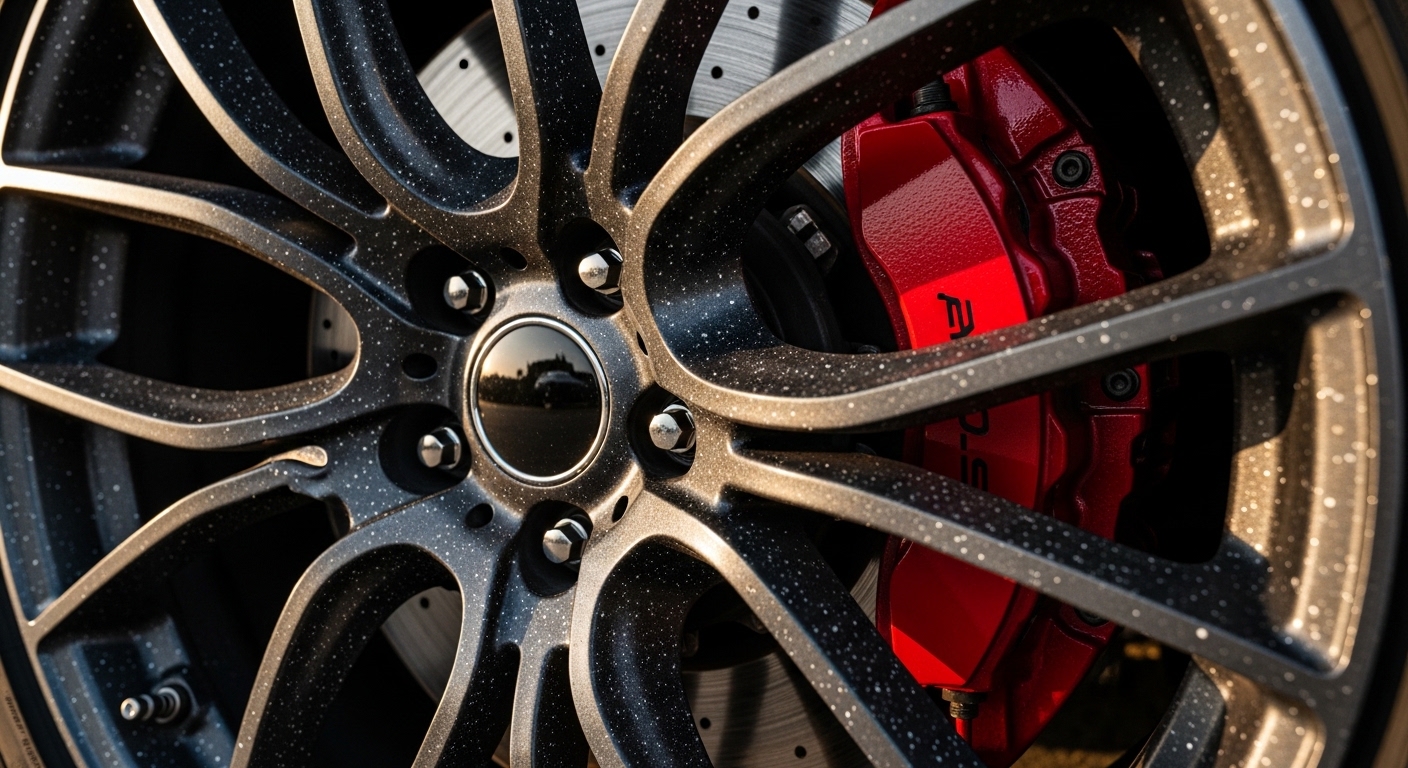
Brake dust vs. brake failure, this is a question many drivers get wrong every single day. You look at your wheels and see dark dust all over them. Your heart sinks. You think, “Is something wrong with my car?” But here is the truth: most of the time, that dust is completely normal. The tricky part is knowing when it is just normal wear and when it is trying to warn you about something serious.
What Is Brake Dust and Why Does It Appear?
The Simple Science Behind Brake Dust
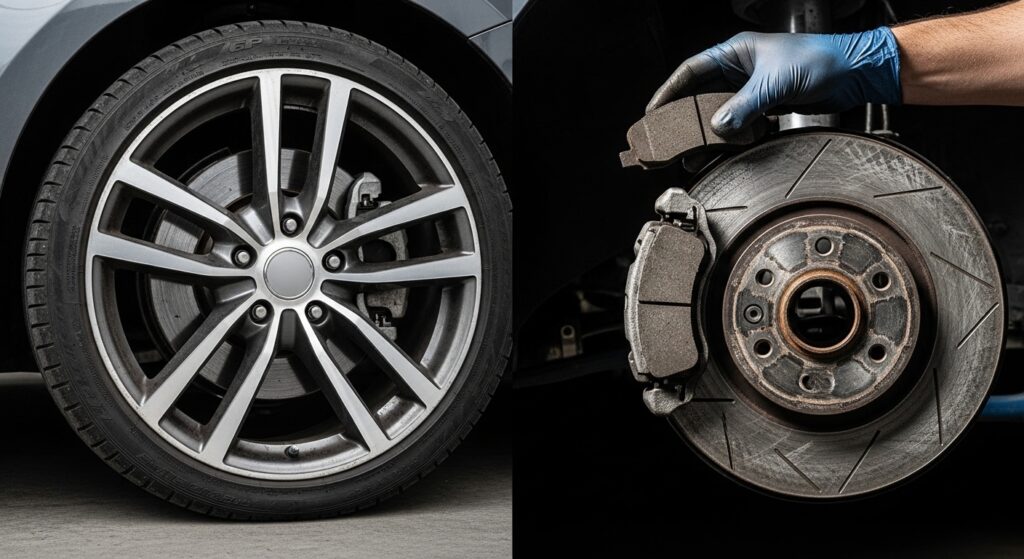
Brake dust is the dark, grayish-black powder you see on your car’s wheel rims, especially on the front tires. Every single time you press your brake pedal, your brake pads press hard against the brake rotors. That pressing creates friction. That friction grinds tiny pieces of metal and other material off both the pad and the rotor. Those tiny pieces fly off and stick to your wheels. That is your brake dust.
I remember the first time I noticed thick dark dust on my front wheels. I panicked and called my mechanic right away. He laughed a little and said, “That just means your brakes are working.” And honestly, he was right.
Brake dust is made of metallic particles, carbon residue, and adhesive material from the brake pad. Around 80% of the dust actually comes from the cast-iron brake rotor being worn down, not just the pad itself.
According to brake component experts at Textar (2025), approximately 80% of brake dust emissions come from disc abrasion rather than the pad material alone.
What Affects How Much Dust Your Car Makes
Not every car makes the same amount of brake dust. The type of brake pad material plays a big role. There are three main types of brake pads:
| Pad Type | Dust Level | Notes |
| Organic / NAO pads | High dust | Softest material, wears faster |
| Semi-metallic pads | High to medium dust | Contains up to 70% metal fibers |
| Ceramic pads | Low dust | Quieter, more expensive, less visible dust |
Your driving style also matters. If you brake hard and fast often — like in city stop-and-go traffic — you will see a lot more brake dust on your wheels. Highway driving produces much less because you use your brakes less often.
Normal Brake Dust vs. Warning Signs You Should Not Ignore
When Brake Dust Is Completely Normal
Some brake dust on your wheels is totally fine. It does not mean your brakes are failing. It just means they are doing their job. Here is how you know it is normal:
The dust appears fairly evenly on all four wheels, or slightly more on the front two. The wheels look dark or grayish but not coated in a thick, heavy layer. Your car still stops smoothly, the brake pedal feels firm, and you hear no strange noises. You have been driving normally without any hard emergency stops.
Honestly, some cars, especially German cars like BMW and Mercedes, are known for producing much more brake dust than Japanese cars. This is because they often use softer brake pad materials designed for better stopping power. More stopping power means more dust. That is just the trade-off.
Red Flags: When Brake Dust Signals a Real Problem
Now, here is where things get important. Not all brake dust is innocent. Sometimes the dust on your wheels is telling you something is wrong with your braking system. The biggest red flag is when you see a lot more dust on one wheel than the others.
Watch out: If one wheel has significantly more brake dust than the rest, you may have a frozen caliper or a sticking caliper. This means the brake caliper is pressing the pad against the rotor even when you are not braking. Your pad is constantly rubbing, creating heat, extra dust, and serious wear.
Other warning signs to look for alongside heavy dust include a burning smell coming from your wheels, the car pulling to one side when you brake, a soft or spongy brake pedal, grinding or squealing noises, or vibration in the steering wheel when you slow down.
What Is Actual Brake Failure? Truly Dangerous signs
The Difference Between Wear and Failure
Brake dust is a sign of normal wear. Brake failure is something much more serious. Brake failure means your braking system can no longer slow or stop your car properly. This is a safety emergency.
“Brake failure accounts for roughly 22% of all accidents caused by vehicular problems.” — National Motor Vehicle Crash Causation Survey
There is a big difference between a car that produces lots of dust but stops well, and a car that struggles to stop at all. Do not confuse the two. Brake dust is a cosmetic issue most of the time. Brake failure is a life-safety issue every single time.
Clear Signs Your Brakes Are Actually Failing
Here are the real signs of brake failure you should never ignore:
Soft or spongy pedal: If your brake pedal sinks all the way to the floor or feels mushy, your hydraulic pressure is compromised. This could be air in the brake lines, low brake fluid, or a failing master cylinder. This needs immediate attention.
Grinding metal sounds: A loud grinding noise means your brake pads have worn completely through, and now metal is touching metal. Your rotors are being damaged. This is past the warning stage.
Car pulls hard to one side: A slight pull can mean a sticking caliper. But a strong pull means one brake is not working at all. That is a critical failure.
Burning smell or smoke: If you smell burning from your wheels or see smoke, stop driving immediately. Your brakes could be overheating or completely locked. Continuing to drive can lead to total brake failure.
ABS warning light on: The ABS warning light on your dashboard signals a problem with your Anti-Lock Brake System. This could be a bad speed sensor, hydraulic pump, or low brake fluid. Get it checked right away.
Vibration or pulsating pedal: If the pedal pulses back and forth when you press it, your brake rotors may be warped from excessive heat. This affects your stopping power directly.
According to NHTSA (National Highway Traffic Safety Administration), brake-related issues are among the top mechanical causes of vehicle crashes in the United States.
Brake Dust vs. Brake Failure: A Side-by-Side Comparison
Quick Reference Guide
Let me put this all side by side, so it is easy to understand at a glance:
| Situation | Brake Dust (Normal) | Brake Failure (Serious) |
| Dust on wheels | Even on most wheels | Heavy on one wheel only |
| Pedal feel | Firm and responsive | Soft, spongy, or sinks to the floor |
| Noise | None or faint squeak | Grinding, loud squealing, metal contact |
| Smell | No unusual smell | Burning smell from the wheels |
| Car behavior | Stops straight and smoothly | Pulls to one side, vibrates, slow to stop |
| Dashboard lights | None | ABS or brake warning light on |
| Action needed | Clean wheels regularly | Stop driving and see a mechanic immediately |
The One Test You Can Do Right Now
Want a fast way to check your brakes? Try this simple test. Drive to an empty parking lot. At about 30 mph, press your brakes firmly. Your car should stop straight, quickly, and smoothly without any pulling, shaking, or strange sounds. The pedal should feel solid under your foot.
If anything feels off during that test, do not wait. Get your braking system inspected by a mechanic. I once pushed off a grinding noise for two extra weeks, thinking it was just dust. Turned out my brake pads had worn through completely, and my rotors needed replacing too. What could have been a simple pad change turned into a much bigger repair bill.
Quick tip: Check your wheels every two weeks. If one wheel consistently has far more dust than the others, that is your car telling you something is not right. Do not ignore it.
How to Keep Your Brakes Healthy and Reduce Brake Dust
Simple Habits That Make a Big Difference
You cannot eliminate brake dust. But you can reduce it and take better care of your braking system at the same time. The biggest thing? Brake more gently. When you see a red light far ahead, let your car slow down naturally first before you press the pedal. This is called coasting. It reduces friction, reduces heat, and reduces dust.
Avoid aggressive driving and hard stops whenever possible. City stop-and-go traffic will always create more dust than highway driving. That is just physics. But even in the city, braking earlier and softer will help a lot.
Choosing the Right Brake Pads and Cleaning Your Wheels
If you are tired of cleaning black dust off your wheels every week, consider switching to ceramic brake pads. They produce much less visible dust, last longer, and are quieter than semi-metallic pads. The downside is that they cost more upfront. But many drivers find the cleaner wheels and quieter ride worth it.
To clean brake dust off your wheels, let the wheels cool down first — never spray cold water on hot metal. Use a pH-balanced wheel cleaner made for alloy wheels. Let it soak for about 60 seconds, scrub gently with a soft bristle brush, then rinse and dry immediately. Apply a coat of paste wax every few months to protect the surface and make future cleaning easier.
Never use WD-40 or any oil-based product near your brakes. It can leave a film on the brake rotor and seriously reduce your stopping power.
Conclusion
When it comes to brake dust vs. brake failure, the difference really comes down to this: dust on all your wheels after normal driving is fine. Uneven dust, strange sounds, a soft pedal, or your car pulling sideways when you stop, those are signs that something is wrong.
Your brakes talk to you through sounds, feelings, and yes, even through the dust they leave behind. Learning to listen to those signs is one of the most important things you can do as a driver. Do not wait until you cannot stop your car to take action.
Check your wheels regularly. Brake gently. Choose good-quality brake pads. And if something feels off, get it looked at right away. I would love to hear your experience — have you ever confused brake dust for a brake problem? Drop your story below.
Frequently Asked Questions
Is brake dust always a sign that something is wrong with my car?
No, brake dust is not always a sign of a problem. It is a normal result of your brake pads and rotors creating friction every time you stop. Almost every car produces some amount of dust. It only becomes a concern when you see an unusually large amount on just one wheel, or when it comes with other symptoms like strange noises, a soft pedal, or a burning smell.
What does it mean if only one wheel has a lot of brake dust?
If one wheel has much more brake dust than the others, it is often a sign of a sticking caliper or frozen caliper. This means the brake caliper is not releasing properly and keeps pressing the brake pad against the rotor even when you are not braking. This creates constant friction, extra heat, and more dust on that wheel. You should have it inspected by a mechanic soon.
How can I tell if my brakes are about to fail?
The main warning signs of brake failure are a soft or spongy brake pedal that sinks to the floor, loud grinding or squealing sounds when braking, the car pulling strongly to one side, a burning smell from the wheels, vibration in the steering wheel when you slow down, and the ABS warning light turning on. If you notice any of these, stop driving and get your braking system checked immediately.
Can brake dust damage my wheels over time?
Yes, it can. Brake dust contains metallic particles and carbon residue that are mildly corrosive. If left on your alloy wheels for a long time, especially combined with heat and moisture, it can etch into the clear coat and cause surface pitting or corrosion. The fix is simple, clean your wheels regularly with a pH-balanced wheel cleaner and dry them right after.
Do ceramic brake pads really produce less dust?
Yes, ceramic brake pads produce noticeably less dust compared to organic or semi-metallic pads. They are harder and create finer, lighter particles that do not stick to your rims as visibly. They are also quieter and tend to last longer. The main downside is the higher price. But if clean wheels and a quieter ride matter to you, ceramic pads are a solid upgrade worth thinking about.