
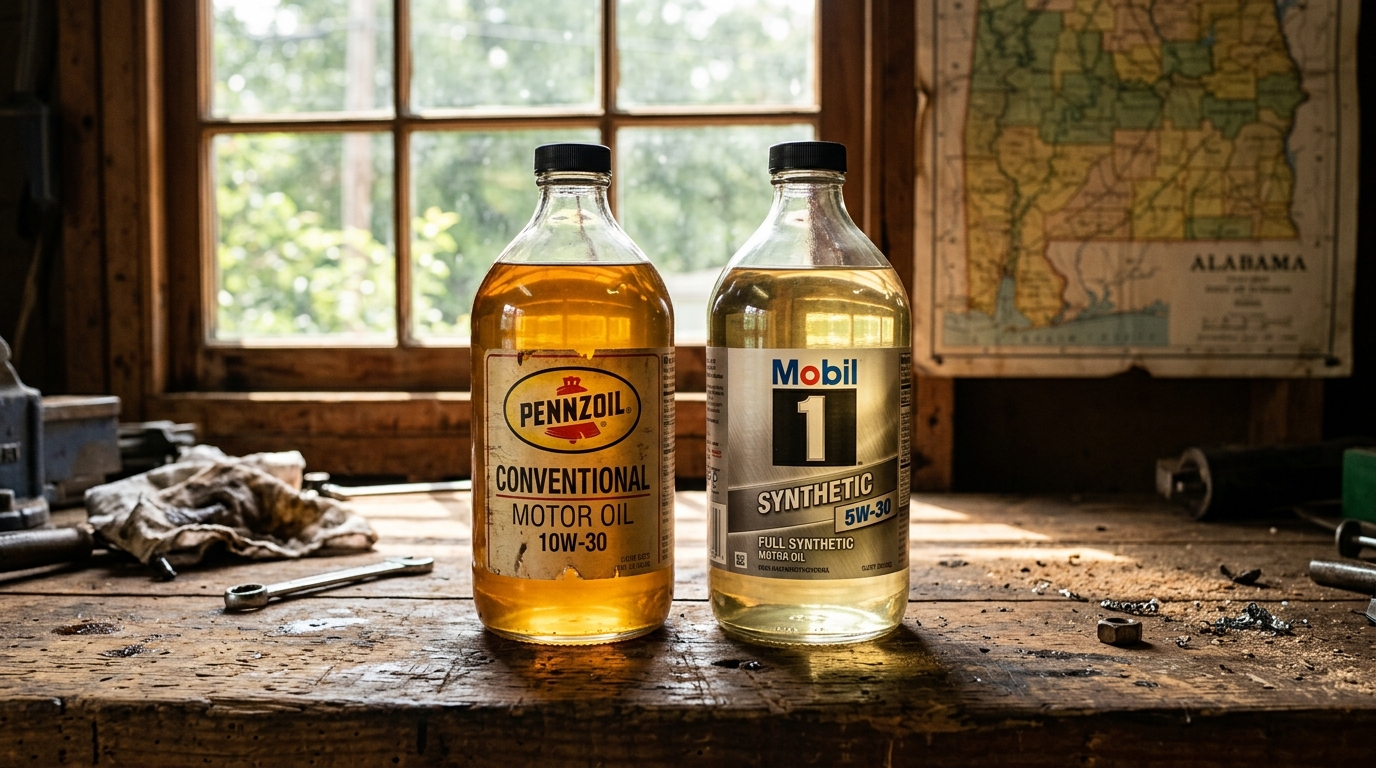
If you live in Alabama, you already know the summers here are no joke. The heat creeps up fast, humidity hangs in the air like a wet towel, and your car’s engine quietly suffers every single mile. I started paying close attention to my oil after my old Chevy started making a low knocking sound one July afternoon on I-65. Turns out, I had been using conventional oil for too long in the wrong conditions. That one mistake taught me more about motor oil than years of casual driving ever did. So let me save you that headache right now.
What Is Conventional Oil and Why Do People Still Use It?
According to AAA, conventional oil, also known as crude oil, exists naturally in the earth’s crust and is pulled from the ground using a drill and pump. It is mainly made up of hydrogen and carbon and may also include small traces of sulfur, nitrogen, and metals.
Because it is less refined and processed than synthetic oil, it is cheaper to produce and cheaper for drivers who want to keep costs low. That is honestly the biggest reason people still reach for it. Not everyone wants to pay more for oil. And for certain cars, that makes total sense.
Most manufacturers recommend conventional oil for most car models. Many mechanics also recommend conventional oil for cars over 75,000 miles because older engines need more lubrication to keep things running smoothly.
So no, conventional oil is not bad. It just has limits. And in Alabama heat, those limits show up fast.
What Makes Synthetic Oil Different?
Here is where things get interesting. Synthetic oil is a lubricant made up of artificially made chemical compounds. These compounds are created by breaking down and then rebuilding petroleum molecules. Under a microscope, a drop of synthetic oil shows millions of molecules all nearly the same size and structure.
Due to the additives and uniform molecular structure, synthetic oil lubricates better, flows better, is less prone to oxidation, and is more stable than conventional oil.
Think of it this way. Conventional oil is like a gravel road. It gets the job done, but there are bumps, rough patches, and things slow down over time. Synthetic oil is like a smooth highway. Everything flows cleanly and keeps moving even when conditions get tough.
There are two main types of synthetic oil: synthetic blend (also called semi-synthetic) and full synthetic oil. The combination of conventional and synthetic oils produces synthetic blend oil. On the other hand, fully synthetic motor oil uses synthetic oil as a base and adds chemicals to keep your car’s engine running at its best.
Why Alabama’s Climate Tips the Scales Toward Synthetic
How Alabama Heat Attacks Your Engine Oil
Alabama summers are brutal. Temperatures regularly climb past 95°F, and the humidity makes it feel even worse. I remember driving back from a fishing trip near Mobile Bay one August. The temperature gauge in my truck crept higher than usual, and I could feel the difference in how the engine was running.
Heat can cause conventional oil to thin out and break down faster. This can lead to poor lubrication and possible engine damage if left unchecked.
In hot climates, engines run at higher temperatures, leading to increased oil breakdown and viscosity loss. This results in less effective lubrication, which can cause increased engine wear and potential damage.
That is what Alabama’s heat does to conventional oil every single summer. It quietly weakens the oil’s ability to do its job.
How Synthetic Oil Handles the Alabama Summer
Synthetic oil is designed to handle more extreme conditions. It flows better at both high and low temperatures. That means your engine stays protected during long drives, uphill climbs, or heavy towing in the heat. It also resists breakdown, which helps your engine stay cleaner and run more smoothly.
Full synthetic oils are engineered to resist high temperatures, which is especially important if you are driving in hot climates or require your engine to work harder, such as while towing or hauling.
For Alabama drivers who commute through Montgomery, drive the long stretches of Highway 280, or tow boats down to the Gulf Coast, this matters a lot. Your oil is working harder than you think.
The Real Performance Difference: What the Numbers Say
Synthetic vs. Conventional Oil in Independent Lab Tests
Most notably, the American Automobile Association (AAA) used certified labs and ASTM standardized test methods to examine differences in engine oils marketed as conventional versus those marketed as full synthetic. Among other things, AAA found that on average, synthetic oils outperformed conventional oils by 47 percent in the conducted tests. The selected tests evaluated several important properties, including shear stability, deposit formation, volatility, cold-temperature pumpability, oxidation resistance, and viscosity changes.
That is not a small gap. That is nearly half again better performance. When you think about your engine running through an Alabama summer, those numbers start to feel very real.
According to AAA Car Doctor John Paul: “In my own cars, I have found by switching to synthetic oil I have had easier cold weather starts, quieter operation, and a slight reduction in engine oil temperature.”
Even an automotive expert switched. That says something.
Oil Change Intervals: How Often You Actually Need to Change Your Oil

One thing people get wrong all the time is thinking synthetic oil is only about performance. It is also about how long the oil lasts between changes.
Experts recommend changing your conventional oil every 5,000 to 7,000 miles. Since you will need more oil changes over time, this may offset the cost savings of a conventional oil change.
Synthetic oil is engineered for consistent performance and lasts up to 15,000 miles, while conventional oil breaks down faster and lasts only 3,000 to 5,000 miles and costs less initially.
When you do the math over a year of driving, the price difference between synthetic and conventional gets much smaller. You are just not changing your oil as often.
Cost Breakdown: Is Synthetic Oil Worth It in Alabama?
Upfront Price vs. Long-Term Value
Synthetic oil is significantly more expensive than its conventional counterpart, sometimes up to twice as much. One AAA study found that switching from a conventional oil to a synthetic oil will cost drivers on average $64 more per year, or an extra $5.33 per month.
Honestly? That is less than one fancy coffee a month. And you are giving your engine a much better life with it.
The same AAA study found that synthetic oil outperformed conventional oil by an average of nearly 50 percent. Switching to synthetic oil could be worth the money, especially if you tow heavy loads or operate in extreme hot or cold conditions. For Alabama drivers, towing a bass boat to Lake Martin or running deliveries through Birmingham in July both count as extreme conditions.
What About Older Cars in Alabama?
This is where I hear the most confusion. People with high-mileage trucks often ask: Should I keep using conventional oil just because my car is old?
Older engines require more lubrication to keep things running smoothly and resist breakdown, so many mechanics recommend conventional oil for cars over 75,000 miles.
A few older cars might leak if you switch to synthetic oil due to the finer molecular structure. It is not common, but if you are switching the oil in an older car, it might be good to clean out the engine first.
So if you have an old car that has always used conventional oil, talk to a mechanic before switching. But for most drivers in Alabama with modern vehicles, full synthetic is the smarter move.
Synthetic Blend: The Middle Ground Worth Knowing About
Who Should Consider a Synthetic Blend?
Not everyone needs to jump straight to full synthetic. For semi-synthetic or part-synthetic motor oils, the base oil is a combination of synthetic and conventional base oils. A properly formulated semi-synthetic can offer performance benefits over a conventional motor oil.
A synthetic blend combines conventional oil with some of the benefits of synthetic oil. It is a good middle ground for drivers looking to improve protection without paying for full synthetic. You will get better performance than conventional, slightly longer change intervals, and a more budget-friendly option than going fully synthetic.
If you are working with a tighter budget but want better heat protection than conventional offers, a synthetic blend is a solid step in the right direction for Alabama roads.
How to Choose the Right Viscosity for Alabama
One thing that often gets skipped in the synthetic vs. conventional conversation is viscosity grade. This is basically how thick or thin your oil is.
For hot climates, focus on the second number in the viscosity grade (for example, the 40 in SAE 10W-40). This number shows the oil’s thickness at 100°C (212°F), which is the standard operating temperature of your engine.
For most Alabama drivers in summer, a 5W-30 or 5W-40 full synthetic works well for everyday driving. If you are towing or running an older engine, a 10W-40 gives you more protection at high heat. Always check your owner’s manual first. Your manufacturer knows your engine better than any article on the internet does.
Conclusion
So what is the Alabama verdict? Here it is plainly: for most drivers in Alabama, full synthetic oil is the better choice. The heat, the humidity, the long highway stretches, and the stop-and-go traffic in cities like Birmingham and Huntsville all put real stress on your engine oil. Synthetic handles that stress better, last longer, and protect more. If you are driving a well-maintained modern car in this state, the switch to synthetic is one of the simplest upgrades you can make for your engine’s long-term health.
Frequently Asked Questions
Is synthetic oil always better than conventional oil for cars in Alabama?
For most Alabama drivers, yes. The hot summers and high humidity put extra stress on engine oil. Synthetic oil flows better at high temperatures, resists breakdown, and keeps your engine cleaner and running more smoothly than conventional oil in heat. That said, very old cars that have always used conventional oil should be checked by a mechanic before switching.
How often should I change my oil if I use synthetic oil in Alabama’s heat?
In hot climates, oil degrades faster due to increased oxidation and thinning. More frequent oil changes, typically every 3,000 to 5,000 miles, are recommended if using conventional oil to prevent engine damage. With full synthetic, most vehicles can safely go 7,500 to 10,000 miles or more. Always follow your owner’s manual.
Can I switch from conventional to synthetic oil in my older truck?
Most cars can use both conventional and synthetic motor oil. However, it is advisable to consult your vehicle owner’s manual or a qualified mechanic first. A few older cars might leak if you switch to synthetic oil due to the finer molecular structure. Clean your engine first if your vehicle has high mileage.
What viscosity oil should I use in Alabama’s summer heat?
For hot climates, focus on the second number in the viscosity grade (for example, the 40 in SAE 10W-40). This number shows the oil’s thickness at the standard operating temperature of your engine. A 5W-30 or 5W-40 full synthetic is a solid choice for most Alabama drivers in summer.
Does synthetic oil really save money in the long run?
Yes, it does. One AAA study found switching from conventional oil to synthetic oil will cost drivers on average $64 more per year, or an extra $5.33 per month. The same study found that synthetic oil outperformed conventional oil by an average of nearly 50 percent. Fewer oil changes and better engine protection over time make synthetic oil worth the price for most drivers.